This website highlights different women in neuroscience at different career stages, and has in-depth profiles on each of them. These profiles are inspiring, interesting, and helpful for anyone trying to learn more about the experiences of different women neuroscientists at various career stages and studying various parts of the field!
“Women in Neuroscience: Four Women’s Contributions to Science and Society” is a review article that discusses how women’s contributions to Neuroscience have historically been undervalued, and then highlights important work from four women neuroscientists: Dr. Sandhya Koushika, Dr. Eve Marder, Dr. Mary Jeanne Kreek, and Dr. Yasmin Hurd. Read the article to find our more about their inspiring work, as well as about equity in neuroscience more generally!
This article is based on this paper, and here is a twitter thread diving deeper into it by one of the authors.
“Why we need female mice in neuroscience research” is an article that dives into the findings of this paper (“Mouse spontaneous behavior reflects individual variation rather than estrous state“) and discusses its findings that female mice have spontaneous behavior that is only “negligibly affected” by hormonal cycles, and actually have less variable spontaneous behavior than male mice. It then goes on to discuss how in neuroscience male mice are traditionally used, and since many of our findings about genes, neural circuits, and behavior are based on mouse research, using only male mice can prevent neuroscience from learning about how these aspects may differ in and impact females.
This paper is written by Mytien Nguyen, Sarwat I. Chaudhry, Mayur M. Desai, et al
This paper describes a cross-sectional study investigating the gender, racial, and ethnic diversity of NIH investigators in the last 30 years. This investigation found that, among PI’s receiving 3 or more research grants in this time period, female and Black PIs were significantly underrepresented. Read more about this here!
This paper discusses the importance of tenure letters and gives concrete recommendations for how to write tenure letters that are inclusive and anti-racist. Read more about this here!
This paper is written by J. A. Ricard, T. C. Parker, E. Dhamala, J. Kwasa, A. Allsop & A. J. Holmes
Here is a twitter thread summarizing it by one of the authors
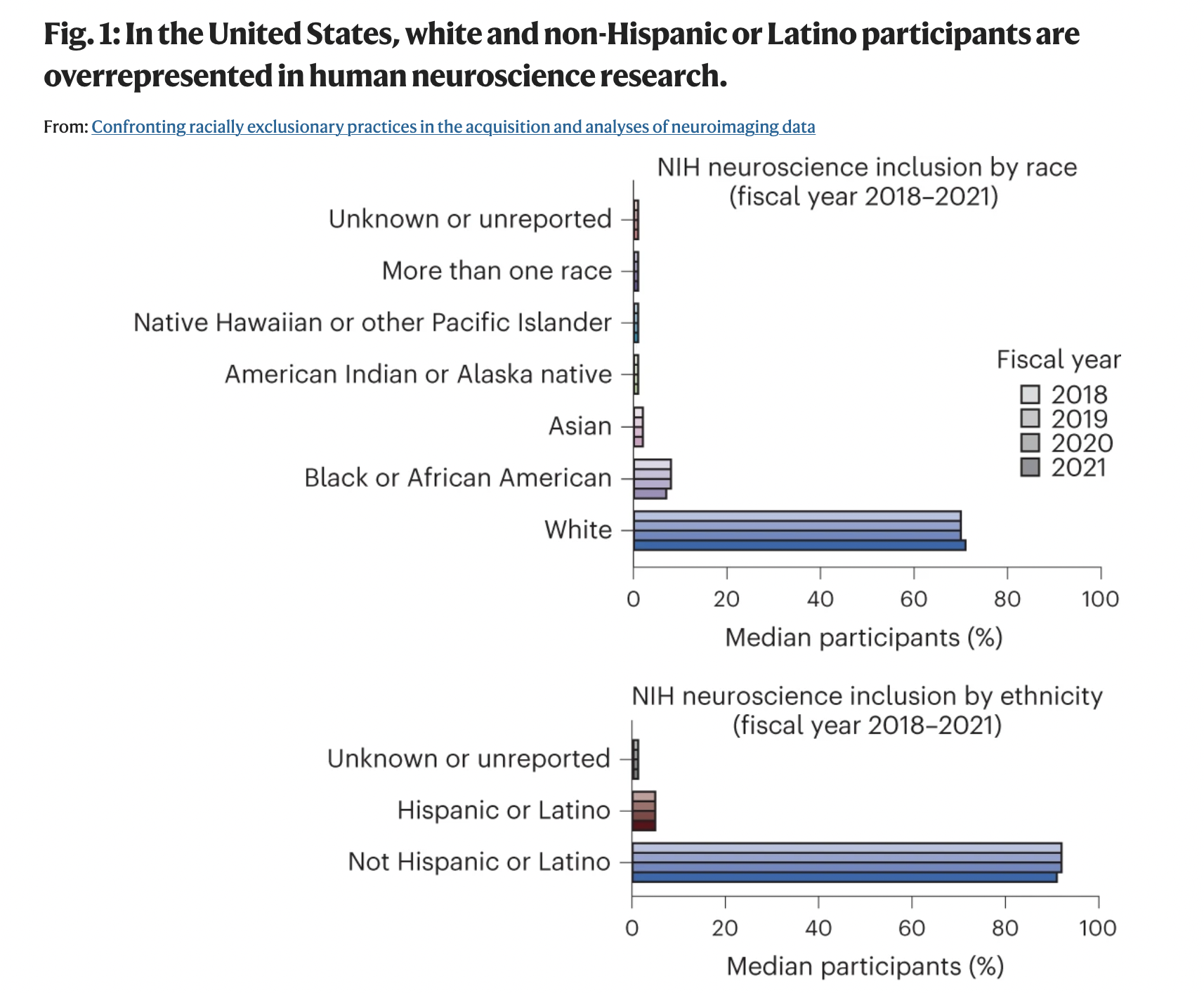
This paper discusses how the process of science (how we recruit, the methodologies we utilize and the analyses we conduct) have large effects on the equity and generalizability of scientific discoveries. Following this, the authors develop new actionable ways to help address these issues in Neuroscience and Psychology studies. Find out more here!
This article discusses neurodivergence, and the experiences neurodivergent workers have in academia. It also spotlights interviews of neurodivergent researchers (Aimee Grant, Ouissam El Bakouri, Heather Newell, Jennifer Leigh), who share what changes they’d like to see for a more equitable workplace. Read the interviews and the article here!
The Black in Neuro website is an amazing resource aimed at diversifying the neurosciences by building a community that empowers Black scholars and professionals in Neuroscience (and related fields). The website has many great resources, including links to events/seminars, a membership and a membership directory for the BiN community, a list of reports and publications relevant to the mission, and a compilation of Black-led initiatives aimed at improving mentorship and outreach in STEM. Go check out these (and so many other) resources on the website!
This article is written by Flavio Azevedo, Sara Middleton, Jenny Mai Phan, Steven Kapp, Amélie Gourdon-Kanhukamwe, Bethan Iley, Mahmoud Elsherif, & John J. Shaw
This article shares the authors’ experiences of navigating academia as neurodivergent researchers. It has a lot of meaningful information about what neurodiversity is, how it is (often negatively) represented in psychology (and how it should be represented instead), and the challenges neurodivergent researchers face within academia. Additionally, the authors share concrete recommendations for how we can support neurodiversity in academia, such as by implementing universal design principles.
Read the article here for a lot more details and insightful points!
The women in neuroscience website is a great resource for finding women neuroscience researchers to collaborate with or invite to conferences/symposiums. By looking through a repository like this when planning speaking events, we can slowly begin to bridge the gap between the ratio of women neuroscientists in the field, and the ratio of women speakers at neuroscience events.
Additionally, this website has a great list of resources that feature publications and articles which focus on diversity and equity within neuroscience, as well as a great list of tips for conference organizers to be mindful of!




 biaswatchneuro