This paper discusses the importance of tenure letters and gives concrete recommendations for how to write tenure letters that are inclusive and anti-racist. Read more about this here!
conferencelink August 20-September 3, 2023 Organisers: Michael A. Buice, Saskia de Vries, Adrienne Fairhall, Shawn Olsen, and Eric Shea-Brown
Faculty gender ratio: 7 Women: 11 Men (39%) Estimated base rate of women in the field: 32.5%* BWN rating: 3, within one standard deviation above base rate
conferencelink March 25-28, 2023 Organisers: Cognitive Neuroscience Society
Invited symposium talks and keynote gender ratio: 9 Women: 11 Men (45%) Estimated base rate of women in the field: 52%* BWN rating: 2, within one standard deviation below base rate
conferencelink March 13-14, 2023 Organisers: Laura Busse, Tim Vogels, Blake Richards, Jessica Cardin, Michael Long, Kanaka Rajan, Andrew Saxe, Anna Schapiro, Christopher Summerfield, Aman Saleem, Hysell Oviedo, Grace Lindsay, Carlos Stein Brito, Angela Langdon, Sashank Pisupati
Total talks speaker gender ratio: 9 Women: 6 Men (60%) Estimated base rate of women in the field: 26%* BWN rating: 5, more than 2 standard deviations above base rate
*Method of estimation: previously established base rate of women in the computational neuroscience field
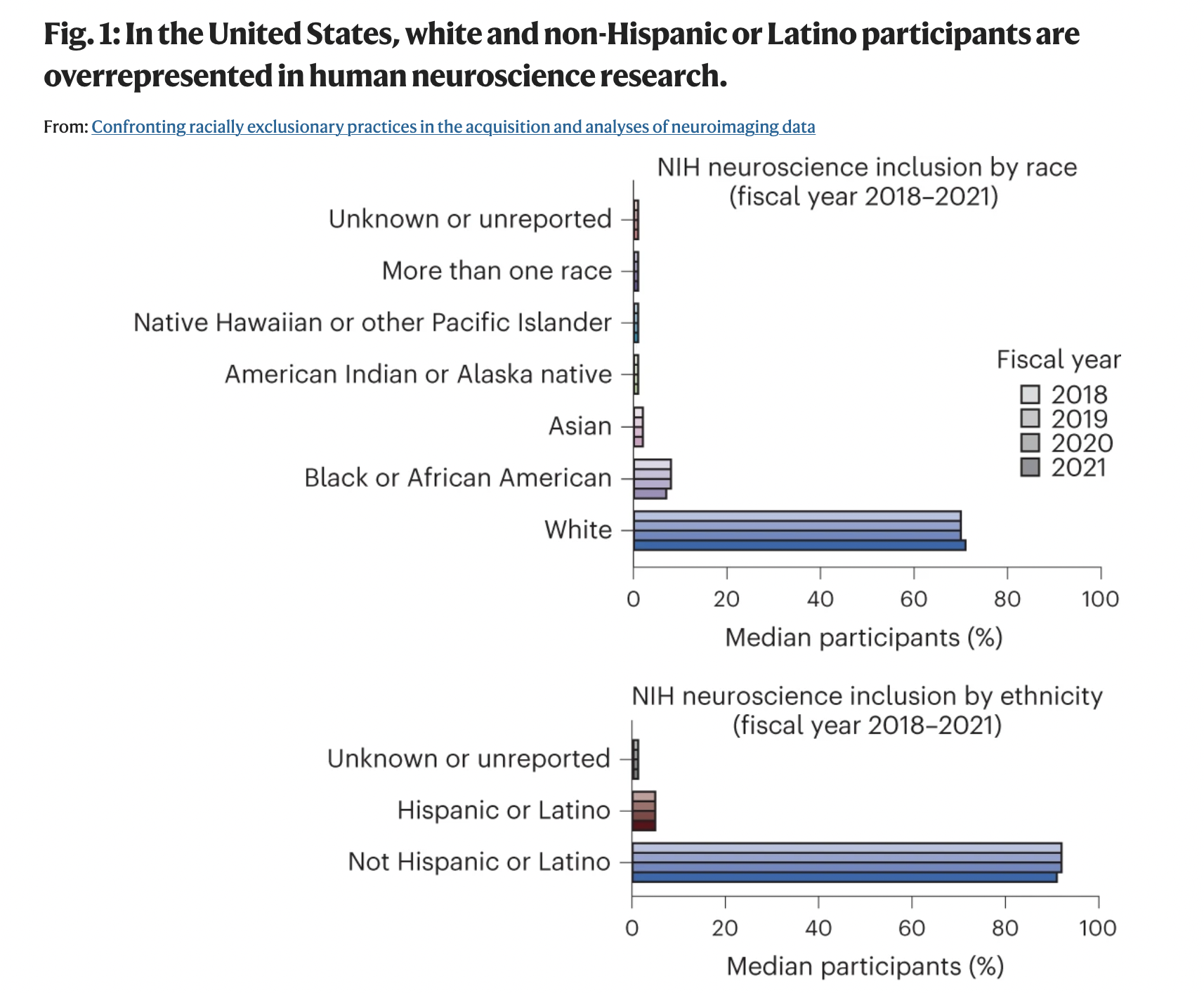
This paper is written by J. A. Ricard, T. C. Parker, E. Dhamala, J. Kwasa, A. Allsop & A. J. Holmes
Here is a twitter thread summarizing it by one of the authors
This paper discusses how the process of science (how we recruit, the methodologies we utilize and the analyses we conduct) have large effects on the equity and generalizability of scientific discoveries. Following this, the authors develop new actionable ways to help address these issues in Neuroscience and Psychology studies. Find out more here!
conferencelink January 23-26, 2023 Organisers: Robert Thorne, Reina Bendayan
Total talks speaker gender ratio: 8 Women: 10 Men (44%) Estimated base rate of women in the field: 43%* BWN rating: 3, within 1 standard deviations above base rate
*Method of estimation: previously established base rate of women in the neuroscience field
This article discusses neurodivergence, and the experiences neurodivergent workers have in academia. It also spotlights interviews of neurodivergent researchers (Aimee Grant, Ouissam El Bakouri, Heather Newell, Jennifer Leigh), who share what changes they’d like to see for a more equitable workplace. Read the interviews and the article here!
The Black in Neuro website is an amazing resource aimed at diversifying the neurosciences by building a community that empowers Black scholars and professionals in Neuroscience (and related fields). The website has many great resources, including links to events/seminars, a membership and a membership directory for the BiN community, a list of reports and publications relevant to the mission, and a compilation of Black-led initiatives aimed at improving mentorship and outreach in STEM. Go check out these (and so many other) resources on the website!
Total invited talks speaker gender ratio: 3 Women: 4 Men (43%) Estimated base rate of women in the field: 26%* BWN rating: 4, within 2 standard deviations above base rate
*Method of estimation: previously established base rate of women in the computational neuroscience field
This article is written by Flavio Azevedo, Sara Middleton, Jenny Mai Phan, Steven Kapp, Amélie Gourdon-Kanhukamwe, Bethan Iley, Mahmoud Elsherif, & John J. Shaw
This article shares the authors’ experiences of navigating academia as neurodivergent researchers. It has a lot of meaningful information about what neurodiversity is, how it is (often negatively) represented in psychology (and how it should be represented instead), and the challenges neurodivergent researchers face within academia. Additionally, the authors share concrete recommendations for how we can support neurodiversity in academia, such as by implementing universal design principles.
Read the article here for a lot more details and insightful points!








 biaswatchneuro